Alright, listen up. Time to put down the phone and get your hands dirty.
**The Hog's Gospel: Reading the Signs**
This new generation of cook is always staring at some blinking light, trustin' a gadget to tell 'em what their own senses were built for. They’re mesmerized by numbers on a screen, completely forgetting to have a conversation with the meat. That firebox is your instrument, not the musician. You play the music. The best instruments you'll ever have are the ones God gave you: a keen eye, a knowing hand, and a nose that can sniff out the truth. Let me teach you how to use 'em.
#### A Lesson in Hue: Chasin' That Perfect Color
First thing to get through your head is that flavor has a color. Out here, we ain't paintin' in beige. A rack of ribs that looks pale and sickly is a downright dishonor to the hog that gave it. We’re hunting for a deep, burnished cordovan—the color of old leather and honest work.
- The First Confession: Right after they hit the heat, the bones will turn a sad, ghostly gray. Don't you dare fret. That's just the meat settlin' in for the long haul, buildin' a canvas for the smoke to paint on.
- The Heart of the Sermon: Now, this is where the spirit starts to move. That color will begin to blush, deepenin' into a shade of ruddy brick. Your job ain't to sit back and watch. You gotta tend to it. Notice a corner gettin' a little too dark? That’s your fire talkin' to you, tellin' you about a hot spot. You listen, and you move the rack. You’re lookin' for a surface that’s got a certain tacky gleam, 'cause that’s what the smoke latches onto. If it looks slick with steam, your fire is choked. Crack the lid and let it breathe.
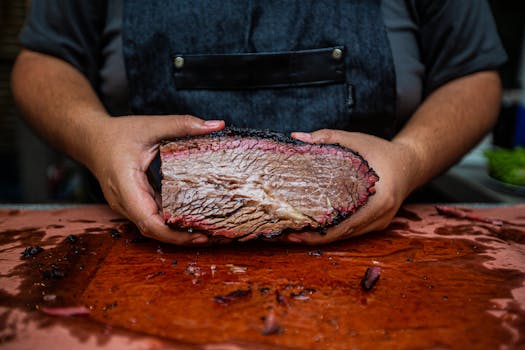
- The Final Benediction: When it’s right, the bark will have a tight, lacquered sheen, not a lick of char on it. But here's the real tell: look at the bones. As that collagen and fat give up the ghost, the meat itself will shrink back from the tips. You see a good quarter-inch of bone standin' proud and clean? That, my friend, is the promised land.
#### The Layin' on of Hands: How Meat Ought to Feel
This is the moment most folks panic and reach for that metal spike they call a thermometer. Don’t you do it. A number tells you the temperature in one tiny spot. Your hands can read the whole story, from cover to cover.
- The Toothpick Test: Before you grab tongs, grab a simple splinter of wood. Forget fancy gear. Ease that toothpick into the thickest part of the meat, right between two bones. Does it fight you? Feel like you’re pushin' into a cold block of lard? It ain't ready. All that connective tissue is still clenched up. But when that toothpick slides home with nothin' but a whisper, feeling like it's gliding into a jar of warm peanut butter… that’s the feeling of surrender. That’s ‘done.’
- The Gospel of the Bend: Here’s the cornerstone. Grab that rack at one end with your tongs and lift it. When it’s raw, it’s a stiff plank. When it’s almost there, it’ll sag just a little. But when it’s truly ready, that whole rack will bow into a perfect arch. As it bends, you’ll see the bark start to develop fine little cracks, like old pottery. It's got backbone, but it knows when to bow. It yields. That’s the sign that all the tough stuff inside has melted into pure glory.
- The Quiver of Truth: This here is a secret the screen-watchers will never know. Lay the rack down and give the center a gentle poke. A rack that needs more time will feel dense and solid. But a finished rack? It’ll have a gentle, gelatinous wobble to it. That meat will jiggle. That quiver is the proof that the tough muscle has been reborn into tender, juicy strands of pork perfection.
#### Preachin' with Smoke: The Scent of Victory
Your nose is the old wise man of barbecue. It knows things before your eyes and hands do, and it will never lie to you. From the second that meat hits the grate, you need to be listening to the sermon of the smoke.
- The Opening Prayer: At first, the air just smells of fire and raw pork. It’s a sharp, almost biting scent. It's the smell of potential.
- The Transformation: But after a few hours, the whole story shifts. The harsh tang of combustion mellows out and somethin' magical takes its place. The fat starts to sing as it renders, its vapor mingling with the sweet woodsmoke. The rub's sugars start to caramelize. It’s not just the smell of ‘smoke’ anymore. Hell no. It’s the unmistakable, soul-stirring perfume of barbecue. It’s a holy union of rendered hog, toasted spice, and seasoned oak. When your whole damn yard smells like heaven's own kitchen, you know you're almost home.
Alright, settle down and listen up. Here's how it ought to be said.
The Difference: Makin' Grub vs. Wieldin' an Art
You wanna know the point of all this fuss? Why a man would chain himself to a smoker instead of just punchin' a clock on a piece of meat? Because treatin' barbecue like some sterile math problem is how you get a predictable, dead-on-arrival product every time. That's manufacturing, not cookin'.
Every slab of ribs that crosses my block has its own damn story to tell. This one’s got veins of fat like a roadmap to glory; that one over there is lean and mean. The very air you're breathin', the mood of the wood you're burnin', the temper of your fire—a little ticking box on the counter don't know nothin' about the soul of these things.
Clinging to some rigid 3-2-1 formula you found online is the barbecue equivalent of a paint-by-numbers kit. Sure, you'll color inside the lines. You’ll wind up with somethin' that vaguely resembles the picture, but it's got no heart. No grit. You haven't wrestled with a single decision. The real craft begins when you toss the instructions and learn to see the meat.
The smoke ain't just heat; it's your paintbrush. That rack of ribs ain't just dinner; it's the story you're tellin'. You lay down a whisper of hickory, you stand back and watch how the color deepens, you feel the texture change under your thumb. A masterpiece don't just appear 'cause a buzzer went off; it’s coaxed into existence.
More than anything, this way of doin' things forces you to be part of the process. You're plugging into somethin' ancient, a tradition of tamin' fire that goes back further than any recipe book. This ain't about following a script; it's about having a conversation. That meat'll talk to you, if you're quiet enough to listen. It'll tell you when the bark's locked in tight, when that fat's finally given up the ghost and turned to liquid gold. Your only job is to learn the language it's speakin'.
And when the fire decides to get ornery and run hot? The fella who lives by the clock, he panics. But a true pitman? He feels that heat on his arm. He sees the bark gettin' a little too ambitious with its color. He gives the slab a gentle nudge and knows from the tension that it’s time to move it to a cooler corner or swaddle it in butcher paper ahead of schedule.
That right there is the gulf between a line cook followin' orders and a craftsman who understands his fire. With every cook, you're bankin' a memory in your bones. You’re building an instinct that no website can teach you and no gadget can replace. That’s the kind of know-how that turns a backyard cookout into a legend.