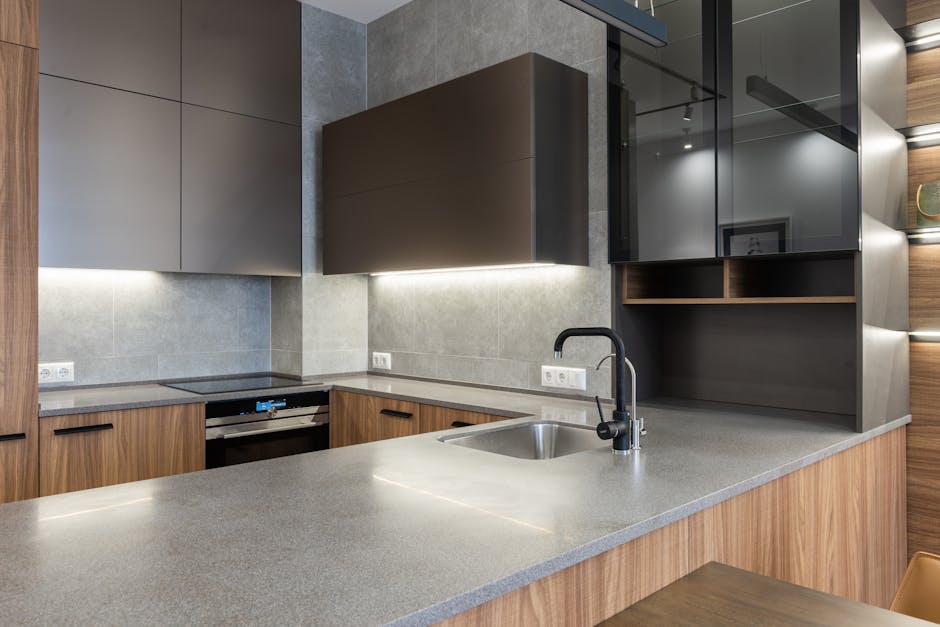
Alright, listen up. Time to stop thinking about your kitchen as a showroom and start treating it like the workshop it is. We're going to gut the "organizer" nonsense you've been fed and rebuild with a logic that's been battle-tested by decades of fire, sweat, and service.
**Ditch the Library Logic: How to Set Up Your Kitchen Like a Pro**
Ever watch a seasoned pro on the line? It’s a blur of motion, but they’re barely moving. Everything they need—oil, salt, pan, tongs—is within a flick of the wrist. Their entire universe is a tight, efficient dance in a three-foot space. Meanwhile, at home, you’re running a kitchen triathlon just to make spaghetti. The fundamental flaw is that you’ve been taught to organize like a librarian, pigeonholing your gear by category. Spices live on a tiered rack, oils are lined up in the pantry, and utensils are jumbled in a drawer. That’s how you build a museum, not a functioning workshop.
Let’s tear it down. We’re rebuilding based on motion, not just neat little categories.
1. Define Your Command Center: The Cook’s Cockpit
Go plant your feet directly in front of your stove. Now, without taking a step, swing your arms out in an arc. That, right there, is your strike zone. Anything—and I mean anything—you touch while the heat is cranking needs to live within this space.
This means your workhorse tools—the trusty tongs, that flexible fish spatula, a sturdy wooden spoon—don't belong in a drawer on the other side of the island. Get them into a crock right beside the burners. Forget stashing your salt in the pantry; it belongs in a salt pig on the counter, ready for a three-finger pinch. Your go-to cooking oil, whether it's olive or canola, should be decanted into a squirt bottle right next to its partner, the salt.
What about that meticulously alphabetized collection of 40 spices? It’s a tactical disadvantage. Identify the 5-7 heavy hitters you grab for 90% of your cooking—think black peppercorns, chili flakes, cumin, maybe some dried oregano. These are your starting players. Get them into your cockpit, either on a small magnetic rack or in simple shakers. The rest of the spice arsenal? They can stay in the pantry, the "library." You’re not disrespecting your sumac; you’re just benching the specialty players until you need them.
2. Build Mission-Specific Zones, Not General Categories
Your kitchen isn’t a single room; it’s a collection of workstations, each designed for a specific mission. Consolidate your gear around the task it performs.
- The Mise en Place Hub: Locate your largest, clearest stretch of counter space, ideally the one flanking the sink. This is your prep zone. Directly beneath this surface, in the cabinet, is where your cutting boards, mixing bowls, and colanders must live. In the drawer immediately below, house your primary knives and vegetable peeler. The logic is brutally simple: the tool is stored directly underneath the battlefield where it will be used.
- The Bakeshop Arsenal: For those who bake, it's time to stop the scavenger hunt. Dedicate a specific cabinet or a rolling cart as your self-contained toolkit. Inside, you’ll marshal your flour, sugars, leaveners (baking soda/powder), vanilla, mixing bowls, and all measuring implements. When inspiration strikes, you deploy one cohesive unit, not fifteen components from fifteen disparate locations.
- The Morning Ritual Zone: Why are you running a three-cupboard relay before you've had a single sip of coffee? Create a unified station. Your coffee maker, your grinder, your beans, your filters, and your favorite mugs must all coexist in one corner. The goal is to go from zombie to caffeinated human with the fewest possible steps.
3. Engineer a Gravity-Assisted Workflow
In any professional kitchen, we use physics to our advantage, and you should too. We call it a gravity-fed system. The heaviest, least-used appliances—that stand mixer, the hefty Dutch oven—belong on the lowest shelves. This saves your back and clears up valuable real estate.
The gear you use daily—plates, bowls, everyday glassware—belongs in the golden zone, the cabinets between your waist and your eyes. But here’s the game-changing tweak: position them based on the flow of work.
Your clean plates and bowls should be stored in the cabinet most convenient to the dishwasher or drying rack. This simple placement forges an effortless cycle: a dirty plate moves from the table to the sink, from the sink to the dishwasher, and from the dishwasher to its home in the cabinet right next door. From there, it's a short trip back to the table. You've just created a path of least resistance, a downhill current where every task flows logically into the next, minimizing every single step. That’s not just organizing; that's orchestration.
Alright, listen up. Let's get one thing straight.
This is About Your Brain, Not Your Stopwatch
Thinking a well-organized kitchen is just some fussy project for people with too much time is a rookie mistake. What we're really talking about is a fundamental rewiring of your cooking process, one that slashes the mental static and transforms a dreaded chore into a state of genuine creative immersion.
Every time you break your flow to rummage through three different cabinets for a spider strainer or trek to the pantry for cooking wine, you’re shattering your own rhythm. These aren't just minor interruptions; they're tiny moments of chaos that accumulate, breeding a frantic energy in the kitchen. It’s the difference between a cook who moves with purpose on the line and a headless chicken bouncing off the walls. One is conducting a symphony of heat and flavor; the other is just making noise.
Imagine a seasoned chef’s station before service. You think their most-used tools—the finishing salt, the squeeze bottle of oil, the tasting spoons—are just tossed in a drawer somewhere? Hell no. They are in a precise location, reachable by muscle memory alone, right there in their low-boy fridge or the rail above the stove. That specialty blowtorch for the crème brûlée? It lives in dry storage, way out of the way. Their entire setup is engineered for the 95% of moves they make every single service, not the 5% they might need once a month. This is battle-tested ergonomics. So why on earth would you store your everyday kosher salt next to the saffron you bought two years ago, just because they’re both “spices”? That’s organizing for a photo, not for function. One is an ingredient; the other is a garnish. Place them according to the action you take.
This discipline also completely revolutionizes your cleanup game. When every spatula and mixing bowl has a designated slot rooted in its purpose, tidying up ceases to be a conscious decision. It becomes a reflex. You’re no longer “putting stuff away”; you’re executing a zero-point reset of your station for the next meal. That mental shift is massive. It builds an instinct for order and readiness that makes stepping into your kitchen to cook the next day feel like a fresh start, not a return to a disaster zone.
Ultimately, the whole point of this system is to eliminate resistance. Cooking is already a gauntlet of challenges: how to keep the fish from sticking, how to balance a vinaigrette, how to juggle three pans so they all land on the plate hot. Your kitchen’s layout should be your trusted ally in that fight, not another adversary you have to wrestle with. By engineering your space for pure function, you liberate your focus for the only thing that actually ends up on the plate: the food itself.