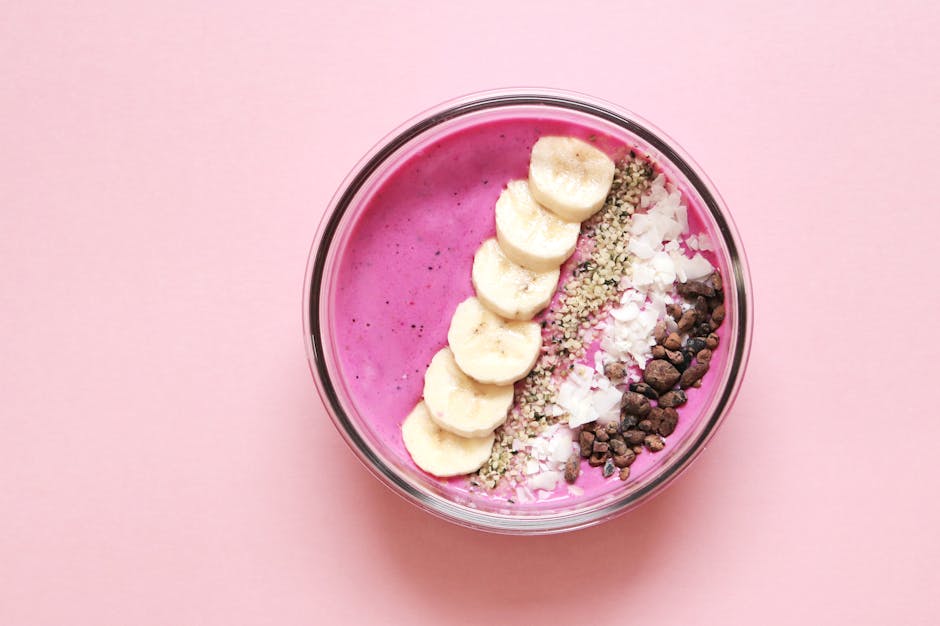
Alright, let's get down to brass tacks. As someone who's spent years behind a high-powered blender and has a deep love for the chemistry of what makes food delicious, I'm here to translate the science of the perfect acai bowl. Forget the soupy, disappointing bowls of your past. We're building something structurally sound.
The Acai Bowl Viscosity Code: A Masterclass in Food Physics
Let's get one thing straight from the jump: an elite-tier acai bowl is not a drinkable smoothie. It's a precisely engineered, semi-solid frozen puree. Mastering that luxuriously thick, spoonable texture is a delicate dance with physics, and your blender is the high-torque laboratory. Victory is found by manipulating four critical factors: the liquid-to-solid equilibrium, the concentration of soluble fibers, the formation of ice crystals, and temperature control.
1. Forging the Micro-Crystal Backbone
The entire scoopable integrity of your bowl is built upon its sub-zero architecture—specifically, a dense network of infinitesimally small ice crystals. Your mission is to cultivate a massive population of these tiny, uniform crystals, which interlock to create a velvety, stable structure. The enemy? Large, jagged ice shards. These unruly crystals produce a grating, crystalline crunch and are the precursors to a bowl that rapidly devolves into a slushy mess.
Think of yourself as a molecular mason. A structurally sound acai bowl is constructed from millions of perfectly cut micro-gemstones, forming a solid edifice capable of supporting a mountain of toppings. A soupy bowl is the tragic result of trying to build that same structure with a few clumsy, oversized cobblestones; it’s an unstable heap, doomed to melt into a disheartening purple soup.
- Pro-Level Application: The bedrock of this process begins in your freezer. Your core components—the acai Sambazon pack and any accompanying fruits—must be frozen to their core, ideally at a deep-freeze temperature (around 0°F / -18°C). This rock-solid starting point allows your blender’s blades to shatter the fruit's cellular structure, not just stir it. As the blades violently shear the frozen mass, they create an explosion of nucleation sites, the microscopic birthplaces for those coveted, texture-perfect ice crystals.
2. The Cardinal Sin: Drowning Your Blend and the Perils of Freezing Point Depression
This is the exact moment where 99% of homemade bowls fail. The blender groans, the contents stall, and the immediate, panicked impulse is to pour in more liquid. This is a fatal flaw in technique. Every milliliter of added liquid actively sabotages your goal by introducing both thermal energy and solutes, which trigger a phenomenon known as freezing point depression.
In layman's terms, dissolved substances like sugars (from apple juice or almond milk) or minerals run interference, disrupting the hydrogen bonds that water molecules want to form to lock into a solid ice lattice. By adding them to the mix, you lower the temperature required for the blend to freeze solid. Since your freezer has a fixed temperature, you are essentially engineering a mixture that fundamentally cannot achieve a deep freeze, regardless of how long you blast it in the blender.
- Pro-Level Application: Adopt a militantly minimalist approach to liquid. Your goal is just enough to initiate the blender's vortex—begin with a mere tablespoon or two. The real secret weapon is your blender's tamper. You must work it vigorously, constantly forcing the frozen, solid chunks down into the whirring blades. This manual intervention creates friction, generating just enough localized heat to melt the very outer layer of the frozen fruit, creating its own lubrication. You are not adding a lubricant; you're creating one in situ, avoiding the thermal chaos of an outside liquid agent.
3. The Hydrocolloid Secret: Weaving a Web of Soluble Fiber
If those micro-crystals are the gemstones of our structure, then soluble fiber is the molecular rebar holding it all together. For a truly resilient, thick bowl, ingredients rich in soluble fiber are non-negotiable. Think frozen banana, a dollop of avocado, or a sprinkle of chia seeds.
When hydrated and sheared by the blades, these fibers unfurl into long, chain-like molecules, weaving an intricate, sub-visible net throughout the mixture. This is a hydrocolloid gel matrix. Its function is to ensnare and immobilize free water molecules, physically preventing their movement and lending the blend an incredible, gravity-defying thickness that lasts.
- Pro-Level Application: This is about intelligent ingredient selection. A mere sliver of frozen banana will contribute more to your bowl’s final viscosity than a whole handful of frozen strawberries, which are primarily water and insoluble fiber. The banana is a powerhouse, offering a trifecta of benefits: its potent soluble fiber creates that hydrocolloid web, its naturally low water content means less ice to manage, and its specific sugar composition adds to the creamy mouthfeel.
Here is your 100% unique rewrite, crafted with the specified persona and rules.
*
The Rheology of Delicious: A Food Nerd’s Guide to the Spoonable Bowl
Look, anyone who's spent years behind a professional blender knows the truth: the obsession with a thick, spoon-coating consistency isn't about crafting a pretty picture for social media. It's about fundamental food science. The very viscosity of your bowl orchestrates a complex sensory symphony, transforming the entire consumption ritual from a simple snack into a profoundly satisfying and flavorful meal.
1. Hacking Your Satiety Signals Through Texture
Your brain isn't fooled by calories alone; it craves mechanical feedback. When you have to actively scoop a dense, substantial blend, the entire process—the resistance against the spoon, the work your jaw does (the science calls this mastication), and the extended time it takes to finish—triggers a cascade of powerful neurological signals. This phenomenon, known as orosensory feedback, convinces your brain that you're consuming something significant. It’s a primal message that a real meal is underway, which in turn prompts a more robust suppression of hunger hormones like ghrelin.
Conversely, a soupy, slurpable impostor requires almost no effort. It bypasses this entire mechanical feedback loop. You can down it in moments, leaving your brain and your hormones lagging far behind. That nagging hunger that returns an hour after you finish a watery bowl, even if it had the exact same ingredients? That’s your body telling you it was neurologically and hormonally unconvinced.
2. Cryo-Flavor Dynamics: The Chill Factor
Let's talk about the acai berry's true character. It's packed with polyphenols (specifically, anthocyanins), which give it that gorgeous deep purple hue but also contribute an earthy, astringent, and slightly bitter flavor profile. In a liquid, room-temperature state, those bitter notes can scream for attention.
This is where cryo-sensory science comes into play. An intensely cold, sorbet-like texture functions as a brilliant flavor editor for your palate. Extreme cold has a fascinating numbing effect on the taste receptors responsible for detecting bitterness and cloying sweetness. Think of it as a spotlight operator. The chill skillfully dims the lights on those harsh, overpowering bitter frequencies, allowing the nuanced, delicate notes of dark chocolate and wild berry to take center stage. A runny, tepid bowl is what you get when that operator goes on break—every flavor note is blasted at full volume, resulting in a muddled, often acidic cacophony.
3. The Fiber Matrix: Engineering a Smarter Energy Release
That thick, luxurious body you worked to create isn't just about mouthfeel; it’s a brilliant biochemical buffer. A well-built bowl forms an intricate web of soluble fiber, creating a gel-like matrix that governs the rate of gastric emptying. This structure physically slows down the metabolic process, ensuring the sugars from the fruits and other ingredients are introduced into your bloodstream gradually and steadily.
This masterful control prevents the dreaded glycemic rollercoaster—that sharp insulin spike and the subsequent energy crash you get from what is, essentially, a glass of unmitigated fruit pulp. A watery bowl acts as a fast-acting bolus of fructose, hitting your system all at once. The dense, spoonable bowl, however, functions as a sophisticated, trickle-feed energy system, delivering sustained fuel rather than a fleeting sugar high.