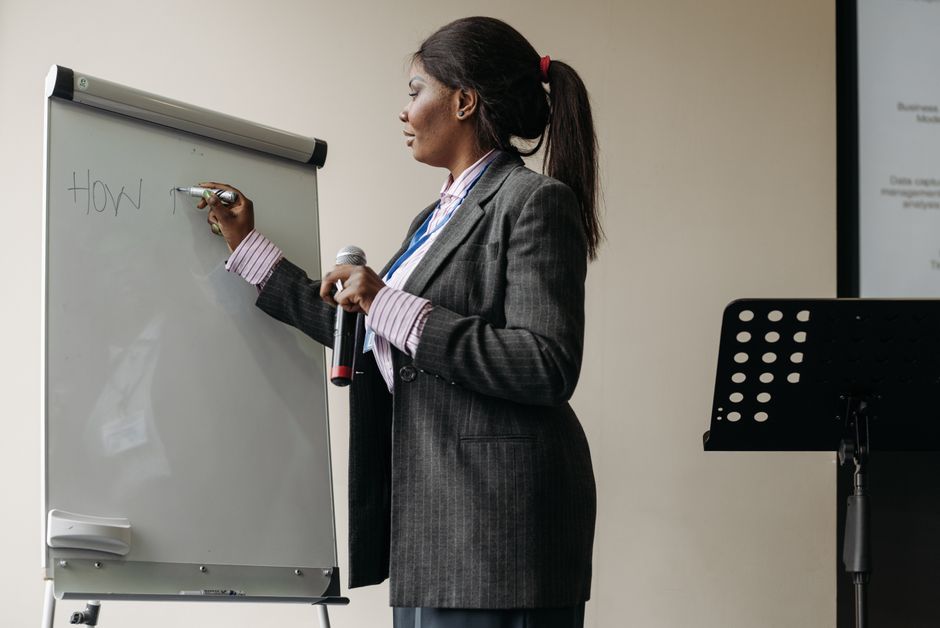
Alright, let's get our lab coats on. We're not just looking at a stained whiteboard; we're conducting a forensics investigation at the micron scale to understand why those phantom marks persist.
The Engineered Perfection of a Whiteboard Substrate
Before it's ever touched by a marker, the flawless topography of a new whiteboard is a marvel of material design. Whether the substrate is porcelain-enameled steel, a slick melamine laminate, or some other proprietary coating, its entire purpose is to possess an incredibly low surface free energy. Think of it as the ultimate introvert at a party; it’s engineered to be non-reactive, fundamentally refusing to form any significant intermolecular bonds with the materials that come into contact with it. Its surface is a landscape of engineered aloofness.
The ink itself is a far cry from simple colored water. Instead, that dry-erase marker holds a cleverly engineered chemical cocktail, a slurry with three distinct players:
1. A Fugitive Solvent: This is the vehicle, usually a type of alcohol, whose entire job is to carry the other ingredients to the board and then vanish.
2. Particulate Colorants: These are the microscopic, solid particles of pigment—the actual stuff you see as blue, red, or black.
3. An Oleaginous Release Agent: Here is the real hero of the concoction. It’s a slippery, non-stick polymer, often silicone-based, that's intimately mixed with the colorants.
As you scribe a line across the board, the volatile solvent rapidly flashes off into the atmosphere. What’s left behind is a delicate, friable film of pigment particles, each one individually encapsulated in a lubricating sheath of that release polymer. This polymer forms a critical barrier, preventing the pigment from ever truly touching the board's surface. So, when you swipe with an eraser, you aren't dissolving the mark. You are merely applying a bit of shear force to dislodge these self-contained, non-adherent pigment parcels, sweeping them away like dust bunnies.
The Catastrophic Failure: How Ghosts are Born
So what summons these spectral images? Ghosting is the evidence of a catastrophic failure in that beautifully designed system. The whiteboard's once-perfect surface is subjected to a relentless mechanical assault. Every press of a marker, every swipe of an eraser, and—most destructively—every misguided scrub with an abrasive chemical or rough cloth inflicts damage. This abuse carves out a network of microscopic canyons, pits, and pores, compromising the board's essential non-porous character.
Here's my favorite way to visualize it: Picture a brand-new, high-end non-stick frying pan. You crack an egg into it, and with a flick of the wrist, it slides right off—no sticking, no residue. That’s your new whiteboard. The egg is the marker ink, protected by its own "release agent" (the fat it's cooked in). Now, imagine you've spent a year scraping that pan with a metal spatula. The surface is now a disaster zone of fine scratches. When you cook an egg now, tiny bits of it get trapped and seared into those scratches. No amount of gentle wiping will get them out.
That ghostly residue on your board is precisely the same phenomenon. Those pigment particles have become mechanically entrapped within the degraded surface topography. The protective polymer sheath is no match for these new crevices; the pigment now makes direct physical contact with the board's substrate. It's anchored in place by simple mechanical capture and the subtle pull of weak intermolecular attractions (hello, Van der Waals forces!). Vigorously scrubbing with a dry eraser at this point is counterproductive. You're just burnishing the pigment deeper into the surface's imperfections and likely gouging out even more of them. The "ghost" is simply the population of pigment particles that have become physically locked into the damaged material, beyond the reach of a simple wipe.
Here is the rewritten text, infused with the persona of a materials scientist who geeks out on everyday objects.
*
The Material Science of a Ghost-Free Whiteboard: A Surface Rejuvenation Guide
To truly exorcise the tenacious ink ghosts haunting your whiteboard, you must first grasp what they are on a molecular level. The common impulse is to attack them with brute force, but that’s a fool's errand. Forget the abrasive assaults; this isn't about mechanical obliteration. We're about to engage in a bit of elegant surface engineering.
First, let's diagnose the immediate symptom: the imprisoned pigment. Those stubborn phantoms are essentially chromatic particles, shackled to the board by a dried-out release polymer. To liberate them, you need a solvent capable of a two-pronged attack: first, re-liquefying that adhesive polymer, and second, coaxing the pigment back into a mobile suspension. For this task, high-purity isopropyl alcohol (think 90% or greater) is your molecular crowbar. As a non-polar solvent, it masterfully dissolves the oily polymer chains, breaking the pigment’s bonds with the board's micro-topography. This same principle, by the way, is why scribbling over a fossilized mark with a fresh marker sometimes works wonders; the new ink’s solvents act on the old, re-mobilizing both for a clean getaway.
But clearing out the debris is a fleeting victory. You've merely cleaned the micro-fissures, not healed them. The damaged topography remains, ready to ensnare the next wave of ink. The real art lies in restoring the board's pristine, factory-spec surface smoothness.
This is the moment we elevate from janitorial duty to applied material science.
Our mission is to planarize that eroded landscape—to fill every last nano-crevice and forge a new, impeccably smooth topcoat. The ideal tool for this topographical renewal is a high-grade carnauba car wax or a purpose-built whiteboard conditioning compound. This botanical wax is our micro-filling agent, our liquid resurfacer. Crucially, steer clear of any "cleaner wax" formulations; their embedded abrasives are the enemy, inducing the very surface degradation we aim to repair.
Follow this restoration protocol:
1. Surface Decontamination: Begin with a meticulous wipe-down using isopropyl alcohol. Every trace of ink polymer and skin oil must be evicted from the surface.
2. Film Application & Curing: With a clean microfiber cloth, apply an exceptionally thin, uniform film of the carnauba wax or conditioner across the entire board. Allow it to sit until the carrier solvents evaporate, leaving a translucent haze.
3. Mechanical Planarization & Polishing: Take a fresh, dry microfiber cloth and buff the hazed surface with vigor. This is the critical step. You’re not simply removing the excess; you're using pressure and friction to work-harden the wax into the board's topography, creating a new, ultra-smooth plane while shearing off the surplus.
Think of this process as re-seasoning your whiteboard, almost exactly like you would a cherished cast-iron skillet. A raw cast-iron surface is porous iron. Through layers of heat-polymerized oil, it transforms into a slick, carbonized, non-stick cooking vessel. We are performing a similar material alchemy here. By meticulously working in the wax, you are in-filling the board’s microscopic porosity and creating a new, ultra-low-energy coating.
This micro-thin stratum of wax becomes a new sacrificial coating. It's a renewable, slick surface that intercepts the ink. Now, when you write, the ink’s polymers have nothing to grip, no microscopic valleys to call home.
What you've accomplished is a genuine material reset, effectively winding back the clock on the surface's entropic decay. Markers will glide, and erasures will become complete and effortless once more. This isn't just about aesthetics; it's a profound extension of the object's functional lifespan. You haven't just wiped away a blemish; you have fundamentally restored the non-stick material property that defines a whiteboard's very function, rescuing it from a premature journey to the landfill.